I recently read Robinson Crusoe. It was a book about a 18 yr old that grew up in England while one of his parents was a foreigner that came to England. His parents and friends all wanted him to settle down as a lawyer in England, but Robinson wanted to go out to sea . His father had a talk with him about how the middle class was the best and they did not need to go out and risk their lives ( that that was only for the poor or rich ) and that he should just settle down. Robinson was moved by this , but after a while ( when his friend came and persuaded him to come on a journey with him on a ship ) he left ( he was 19 or older by now ). On this voyage there was a bit of a gale , for the crew , but for Crusoe it seemed like a full storm. He was terrified that they would go down any minute and made vows that he would go home a soon as he could if he survived the gale. His friend gave him some rum and soon after the gale subsided to a calm sea. Robinson decided not to keep the vows and when he was thinking about it he drank some rum ( he was wicked when he was young ). Soon after though there was a really terrible storm, and all the crew was sure it would go down any minute. Crusoe was scared and he went to the pump to pump out water. They got in a boat and left their ship. Soon after their ship capsized. Another ship found them and they got into it. They took this ship to shore. At shore Crusoe met the captain ( whop was his friends father ) and told him about he had left against his fathers will. At this the captain was mad and told him it was his fault they had lost their ship and said he would not take a man like him for 1000 pounds, then told Robinson to go back to his father. Robinson got a ship back to London, but he did not stay long, for there were some men who were going to Guinea in Africa to get rich, and Crusoe joined them. They went to guinea and got a lot of money from gold and things. This was successful so Robinson Crusoe wanted to do it again. He did go on a ship to Guinea, But they were attacked by the Moors and taken prisoner or executed. Robinson stayed a slave for the moors for a long time. His master went on fishing trips and took Crusoe with him since he was very good at fishing. One day there was a fog and they got lost, They did not really have any provisions in the boat and the master got worried. They made it back to shore though and the master ordered the ship to be furnished with more provision and made into a seaworthy boat with a sail . After this , the Moor master was going to have some guests over to fish, so he ordered more provisions added and also guns into the boat , for they might hunt game on land also. But it turned out that the guests did not come, and Robinson Crusoe, a Moor servant and a moor boy went fishing. They went out to deep waters and then Robinson forced the Moor servant to leave and the boy promised to be his slave. So with the provisions , and guns in a sturdy vessel they went south ( where Robinson hoped he woulds find some English colonies , or European ships ). So though their water ran out and they were forced to land at shore. They found a stream and got some fresh water there. There came in the night some animals , but Crusoe scared them off with his gun. Once they landed for water and found a lion sleeping at the riverside. They killed hit and took its hide to lay on. Another time they found some natives, and then a Leopard came , and Robinson shot it. He gave them it and asked for the skin, they agreed, and he set of. Soon he was ear the cape Verde islands and found a Portuguese ship headed for Brazil. When he got on they spoke to him in 4 different languages which he did not know, but finally there was a Scotsman who hailed him. The captain was very nice and bought his boat and hides for a good deal of money. When they came to Brazil , The captain offered to start him in the plantation business, and then offered to have half his money from England turned into tools for the trade and have them brought here. Crusoe agreed, and he had a good start to his plantation business . In 4 years he made a lot of money, learned the Portuguese language and was well off. But he realized this was the middle class station and was what he ran away from. So when a group of plantation owners decided to go on a trip to Africa to get some slaves for their plantations , Robinson agreed. They set off but after a while there was a terrible storm that blew them where they knew not, and when they sighted land they should get in a boat and go there , they rowed towards the rock though and knew they were going to die. But then a giant wave crashed them under and Crusoe barely made it to the surface in time ( before he suffocated ) , and then was pushed under again, He swam ,and fought the stormy sea and tried to get to shore . Finally he made it and lay there exhausted, after a while he went and found a thorny tree which he slept in ( to be safe if the were predators on the land, though there actually turned out to be none ). When he woke up he saw that the ship was driven in the water nearby , and he swam to it. There were many things he could use and he gathered some of them, ( guns, powder , shot , food, clothes and sail canvas ) he went about and made a raft from the boards of the ship ( he also got some nails and tools ) to take his things to shore with. He found a creek and drove his laden raft down it and landed in a cove. Then he went up a hill ( armed, and with much labor ) and discovered he was on an island ( more precisely the island of Trinidad ). On top of thew hill he also found that the island was uninhabited by humans. He came down and worked the rest of the day to get his cargo of his raft and onto the shore ( many of the things were in chests ). He Barricaded himself and went to sleep. The next day he swam to the ship again, gathered useful things again , made a raft again and took the cargo to shore again. On shore he made a tent out of the sail canvas and poles or sticks. He blocked it with chests on the outside and went to sleep. He went to the ship and got more resources 10 more times, and on the last one a storm was starting. He went back to his tent and the storm blew all night. The next day when he woke up to find the ship gone, he was glad he had taken so much from it when he could. His place where the tent was not a good place for settlement ( because it did not have any fresh water near and it was on low ground , this being bad for defenses against the natives who may come to the island ), So he set out to find a good place. He found one, a raised up piece of flat land on the side of a hill with a slight hollow spot in the rock of the hill. He drew a half circle that connected to the wall of the sheer rock and set about making stakes and driving two rows of them on the half circle , and then filled up the space between them with cable ( from the ship ) and more stakes. He then made a ladder to let him get over his wall , Every time he went into his fortification he pulled the ladder into it with him so no one could come in after him. He brought in all his goods with a lot of work and then made a double tent ( one small one in a large one ). He brought his food into the tent so the rain might not spoil it, after this he started making the hollow larger. Time passed in this work and he made a small cave behind his tent. One night there was a thunderstorm and he was worried for his powder , lest it should be hit be lightning and explode and burn. Without the powder he would not be able to hunt and defend himself very well, and also if it exploded he might have died. After this he made many small compartments and separated his powder into these and put them in many different places. Each day he went out with his gun and hunted, for he had found some wild goats, they were fast though and he had to attack them in a valley from above. Robinson Crusoe went on living on the island for 27 or so years, and ( since there was a bible there which he had taken from the ship and read it ) changed to a more hard working good man. He made many advancements on his island home, some are: another home inland , a herd of domestic goats ( he tamed some and then bred them ) , and a wheat field that gave him bread ( he made a process that required a lot of work to make bread ). He discovered that native cannibals sometimes came to the island to eat after a victory in war. At first he wanted to kill them for the savage acts , but then realized they probably did not know that their acts were wrong, so he did not try to kill them . Then a few years before he left , a party of natives came , and one of their prisoners ( for eating ) escaped, Crusoe saw this and helped the escaped prisoner by killing one of the savages that chased him ( he had only 2 chasers on him ) and knocking out the other . The escaped native thanked Robinson mightily and then ( after asking Crusoe for his cutlass, which Robinson gave him ) cut of the now semi-conscious cannibal that had chased him. The escaped native made signs that he would be Crusoe 's slave forever, and Robinson told him his name was now Friday. Crusoe inspired fear and awe in Friday by using his gun, and Friday helped Robinson a lot. He also made Friday more civilized and taught him the christian protestant faith. After some while there came a cannibal party with a white man prisoner with them, Crusoe and Friday attacked them ( killed or wounded most of them and only 3 or 4 got away ) with guns ( For Friday had learned to use them ) and saved the White man. They also found another prisoner who was Friday's father! Friday was overjoyed to see him , and took great care of him. The white man turned out to be a Spaniard, and he and Friday's father became helpers of Crusoe. Robinson learned that there were a group of Spaniards and Portuguese with Fridays people, who had been shipwrecked. Crusoe told the Spaniard and Friday's Father to go to them and ask them if they would come to the island. Robinson hoped they might be able to make a ship with more hands. While they were gone, a ship came and landed on the island. Crusoe and Friday were in their fortification and saw it with a spy glass. They saw that it was an English ship and that the men who came out were English ( mostly ). There were 3 men that seemed prisoners of the rest. The other men left these three on the shore , and went to sleep in the forest. Robinson came and talked to them with Friday. It turned out that they were the captain and a couple of his trusted followers, who had been taken prisoner in a mutiny. They were going to be abandoned on this island while the mutinous crew went away. Crusoe and some others took the mutinous men on the island captive and after a not so short fight with more men on the ship, they took the ship. The captain promised to follow Robinson's orders, the leaders of the mutinous gang were left on the island ( Crusoe taught them how to survive with the improvements he had made , and told them to be nice and live with the Spaniards and others who came ) , and Robinson, Friday and the rest went to England. He had been gone 35 years, and he was a stranger to everyone, except one or two close friend(s). He went to Portugal and back ( on his way back his party met some wolves ) because the captain of that ship which had long ago taken him in , was there. In Portugal he arranged that he would get some money from his plantation with the captain. The book ends soon after he gets back to England. It showed how a not so righteous man can become good after a long time in isolation and hard work.
Note : some things might be incorrect , but it should mostly be right.
Saturday, June 27, 2015

Friday, June 26, 2015
Big Idea 5 : Thermochemistry
Thermochemisty is the thermodynamics of chemistry , and thermodynamics is a branch of physics that studies temperature ,heat, work and energy. It also studies how heat and energy transfer between objects (and in thermochemistry ,between molecules in reactions). First of all , lets explain KE=1/2mv^2 ,which is the formula for kinetic energy or the energy of movement. KE is Kinetic energy, m is mass and v is velocity. You don't use this formula that much in AP Chemistry, so lets move on. The universe can be divided into the system and the surroundings , where the system is what you are studying and the surroundings is everything else. The first law of Thermodynamics states that energy is conserved. The temperature of a substance is ( the measure of ) the average kinetic energy of the molecules in that substance, So at higher temperatures the molecules are moving faster. There are 3 temperature scales : Kelvin , Celsius ( centigrade ) and Fahrenheit. The most commonly used in AP Chemistry is K or Kelvin ( Note that Kelvin's symbol does not have a ° symbol , so you do not say degrees Kelvin , but just Kelvin ) , but °C ( Celsius ) is used sometimes too. The conversion between K and °C is: K=273.15+°C and °C=K-273.15 . Heat is the kinetic energy transferred between objects, when they have different temperatures and collide. In this collision heat goes from the one with a higher average kinetic energy to the one with a lower average kinetic energy until they are the same temperature. Heat Is the total kinetic energy in an object while temperature is the average kinetic energy. The specific heat capacity of a substance is the energy required to raise one gram of that substance by one degree Celsius. The Specific heat capacity of a substance = amount of heat added / (the mass of the substance )( the change in temperature ) , in units of J/g*K . Metals have low specific heat capacities and water has a high one. So water changes temperature slower ( or with more energy ) than metal. You can measure the heat transferred using q=mcΔT , where q= heat transferred , m = mass, c= specific heat capacity and ΔT = change in temperature.
Heating curves are a graph with temperature on the y-axis and Energy added on the x-axis, that starts with a solid and ends in a gas. During the phase changes ( Melting and boiling ) the temperature stays the same because all the energy added is used to change phase. During the time the temperature increases and there is no phase change you can use q=mcΔT, but during the phase changes you have to use another equation. This is q=(ΔHfusion/vaparazation )(moles), where ΔHfusion/vaparazation Is either the standard enthalpy of fusion ( which is the energy ( heat ) change when 1 mole of a substance is converted from solid to liquid ) , or vaporization ( which is the energy ( heat ) change when 1 mole of a substance is converted from liquid to gas ). An Endothermic change for the system is when energy is added to the system , and an Exothermic change for the system is when energy leaves the system. Cooling curves are like heating curves except they start with a gas and take away energy until you get a solid. ΔH° = Change in standard enthalpy , or change in heat (in regular conditions ) ( the standard conditions are shown by ° and are 1 bar and 1 mole and so on ) . The way to find ΔH° of a reaction is to use the equation
ΔH° rxn = the sum of ( ΔH°f products ) - the sum of ( ΔH°f reactants ) , you can look up the ΔH°f ( the change in enthalpy of formation ) of compounds, then multiply them by the number of moles there is in the reaction ( the coefficient ) and add them together to get the ΔH°f reactants or ΔH°f products. Also if you want a ΔH rxn of a reaction but only have ΔH rxns for other reactions that are similar to yours , you can us Hess's Law to find the ΔH rxn of your wanted reaction. The rules are this: 1 If you multiply a reaction by a number you must also multiply the ΔH rxn by that same number. 2 If you flip a reaction equation around then you change the sign of it's ΔH rxn . And 3 when everything cancels except your desired reactants and products , you can add up the ΔH rxns of all the similar reactions you were given to get your desired ΔH rxn. The second law of thermodynamics states that entropy ( disorder ) increases as time goes on. Entropy's symbol is S and is measured in J/mol*K. Since entropy is disorder it increases with changing states from solid to liquid to gas , and thus with temperature ( Also larger molecules have more entropy , than smaller ones ). ΔS is change in entropy , and can be calculated the same way as ΔH°rx can with products - reactants:
ΔS° rxn = the sum of ( S°products ) - the sum of ( S° reactants ) where S° is the absolute entropy of something ( you can look these up too ). Gibbs Free energy is the free energy available to systems to do work and has the symbol ΔG. It can be calculated like ΔH and ΔS:
ΔG° rxn = the sum of ( G°f products ) - the sum of ( G°f reactants ), But it can also be calculated with ΔG°rxn= ΔH°-TΔS°* , Determining the sign of the change in Gibbs free energy for a reaction lets you determine the thermodynamic favorability of the reaction or if the reaction is thermodynamically favorable. If ΔG is negative the reaction is thermodynamically favorable, while if it is positive it is not thermodynamically favorable, or it is thermodynamically unfavorable.
If something is thermodynamically favorable it will happen without outside influence. But somethings that are thermodynamically favorable just happen to slow for us , like graphite turning into diamond, this means they are under kinetic control. Kinetics and Thermodyanmics are separate in AP Chemistry, Kinetics focusing on the rate or speed and Thermodyanmics on favorability.
When something is thermodynamically unfavorable it needs outside energy to make it happen and the reactant formation is favored ( unless you add energy ) , while in thermodynamically favorable reactions the product is favored. The favorable signs for ΔH and ΔS are - and + respectively. So for a Reaction to be thermodynamically favorable, at least one of its ΔH and ΔS has to be favorable, and if only one is then the favorability depends on temperature. for example if both are positive ( ΔH° is unfavorable and ΔS° is favorable ) then to have a negative ΔG° you would need a high temperature ( and the other way around if both are negative ). If both are favorable ( ΔH° negative and ΔS° positive ) then the favorability of the reaction does not depend on the temperature and ΔG° is always negative ( it is the other way around if both are unfavorable , then ΔG° is always positive , and you have to add energy to make the reaction go ). You can couple unfavorable reactions with favorable ones to make an overall favorable reaction, this is called coupling.
FYI
its been some time since I studied for the test so my information may not be completely accurate and there may been some things not covered, my apologies.
* when you do the math with this equation you have to make ΔH° and ΔS° have the same energy unit ( either kJ or J ) since ΔH° is usually in kJ/mol and ΔS° is usually in J/K*mol ( the Kelvin cancels out with the Kelvin in T )
Note: The sources for these blogs ( this , big idea 2, bonding , IMFs and molecular shapes, and AP Chemistry : Kinetics and Rate ) : Wikipedia, my AP class, and my review books ( AP Chemistry crash course, REA and Princeton review 2015 )
 |
| heating curve |
ΔH° rxn = the sum of ( ΔH°f products ) - the sum of ( ΔH°f reactants ) , you can look up the ΔH°f ( the change in enthalpy of formation ) of compounds, then multiply them by the number of moles there is in the reaction ( the coefficient ) and add them together to get the ΔH°f reactants or ΔH°f products. Also if you want a ΔH rxn of a reaction but only have ΔH rxns for other reactions that are similar to yours , you can us Hess's Law to find the ΔH rxn of your wanted reaction. The rules are this: 1 If you multiply a reaction by a number you must also multiply the ΔH rxn by that same number. 2 If you flip a reaction equation around then you change the sign of it's ΔH rxn . And 3 when everything cancels except your desired reactants and products , you can add up the ΔH rxns of all the similar reactions you were given to get your desired ΔH rxn. The second law of thermodynamics states that entropy ( disorder ) increases as time goes on. Entropy's symbol is S and is measured in J/mol*K. Since entropy is disorder it increases with changing states from solid to liquid to gas , and thus with temperature ( Also larger molecules have more entropy , than smaller ones ). ΔS is change in entropy , and can be calculated the same way as ΔH°rx can with products - reactants:
ΔS° rxn = the sum of ( S°products ) - the sum of ( S° reactants ) where S° is the absolute entropy of something ( you can look these up too ). Gibbs Free energy is the free energy available to systems to do work and has the symbol ΔG. It can be calculated like ΔH and ΔS:
ΔG° rxn = the sum of ( G°f products ) - the sum of ( G°f reactants ), But it can also be calculated with ΔG°rxn= ΔH°-TΔS°* , Determining the sign of the change in Gibbs free energy for a reaction lets you determine the thermodynamic favorability of the reaction or if the reaction is thermodynamically favorable. If ΔG is negative the reaction is thermodynamically favorable, while if it is positive it is not thermodynamically favorable, or it is thermodynamically unfavorable.
If something is thermodynamically favorable it will happen without outside influence. But somethings that are thermodynamically favorable just happen to slow for us , like graphite turning into diamond, this means they are under kinetic control. Kinetics and Thermodyanmics are separate in AP Chemistry, Kinetics focusing on the rate or speed and Thermodyanmics on favorability.
When something is thermodynamically unfavorable it needs outside energy to make it happen and the reactant formation is favored ( unless you add energy ) , while in thermodynamically favorable reactions the product is favored. The favorable signs for ΔH and ΔS are - and + respectively. So for a Reaction to be thermodynamically favorable, at least one of its ΔH and ΔS has to be favorable, and if only one is then the favorability depends on temperature. for example if both are positive ( ΔH° is unfavorable and ΔS° is favorable ) then to have a negative ΔG° you would need a high temperature ( and the other way around if both are negative ). If both are favorable ( ΔH° negative and ΔS° positive ) then the favorability of the reaction does not depend on the temperature and ΔG° is always negative ( it is the other way around if both are unfavorable , then ΔG° is always positive , and you have to add energy to make the reaction go ). You can couple unfavorable reactions with favorable ones to make an overall favorable reaction, this is called coupling.
FYI
its been some time since I studied for the test so my information may not be completely accurate and there may been some things not covered, my apologies.
* when you do the math with this equation you have to make ΔH° and ΔS° have the same energy unit ( either kJ or J ) since ΔH° is usually in kJ/mol and ΔS° is usually in J/K*mol ( the Kelvin cancels out with the Kelvin in T )
Note: The sources for these blogs ( this , big idea 2, bonding , IMFs and molecular shapes, and AP Chemistry : Kinetics and Rate ) : Wikipedia, my AP class, and my review books ( AP Chemistry crash course, REA and Princeton review 2015 )
Monday, June 15, 2015
Big idea 2, bonding ,Intermolecular Forces and Molecular Shapes
Atoms bond together with valence electrons.They could share them equally, share them unequally or completely steal them. When they share them equally it is called a Covalent bond. When they share them unequally it is called a Polar Covalent bond. When they completely steal them it is called a Ionic bond. Some examples for Covalent, Polar Covalent and Ionic: Oxygen-Oxygen bond in O2 , Oxygen-Hydrogen bond in H2O and the Sodium-chlorine bond in NaCl respectively. In Polar bonds there is a Slightly or partially positive side and a slightly/partially negative side. The name Ionic comes from the word ion, Which is a charged species ( in Chemistry this could be a atom , molecule or any other particle. But when you get into Biochemistry you have a problem : ), it supposedly has nothing to do with the Ionic column ;). There are 2 different types of Ions: Cations and Anions. The Cations are positively charged ( and are formed by taking away electrons ) and the Anions are Negatively charged ( formed by adding electrons ) . Ionic compounds ( I will tell you what that is next) are formed by Ionic bonds ( which are formed by electrostatic forces pulling the cations and anions together) . A molecule is 2 or more atoms bonded, while a compound is a molecule with different elements in it. The O2 above is a molecule but not a compound. The H2O ( which you might recognize as water ) and the NaCl are molecules and compounds. Intermolecular forces are forces between molecules , while intramolecular forces are forces between atoms in a molecule ( these are also called bonds ). There are 3 main types of intermolecular forces and some others, London Dispersion forces, Dipole-Dipole interactions and Hydrogen bonding ( which is really an extra strong dipole-dipole interaction , and not a bond at all since its inter- ). Dipole-Dipole interactions/forces are attractions between polar molecules, the Partially positive side of one molecule is attracted to the partially negative side on another molecule, as in H-Cl. Hydrogen bonding is ( like I said ) an extra strong type of dipole-dipole forces, which only happens with a hydrogen on an oxygen , Fluorine or nitrogen and another partially negative atom on another molecule. Hydrogen bonding takes place in water and is responsible for the surface tension on the water's surface. Hydrogen bonding is extremely strong ( when I say extremely I mean its stronger than regular dipole-dipole , but not stronger than ion-ion forces ) because Hydrogen has only one electron and it can go on one side while a small partially negative atom ( of another molecule ) can creep up close to the positive nucleus of Hydrogen on the other side. London dispersion forces are the weakest of the three IMFs that I named. But they are dependent on the polarizability of the molecule , which is dependent on the size of the electron cloud . If you have a very large electron cloud molecules , and hence some very polarizable ones you would have strong LDFs. Anyway London Dispersion forces ( LDFs) are instantaneous forces that happen when tat one instant the electrons in a molecule are farther to one side and then it has momentary poles , this induces other molecules around this molecule to have momentary poles and then the molecules are attracted. But this isn't permanent and happens only for a moment, then the electrons go regular again . This happens over and over again, so a force of attraction is seen , but the polarity is not permanent and the force is generally weak ( when you got molecules with large electron clouds it is not so weak ). Every group of molecules have this force, but only in ones where the molecules atoms have very similar electronegativities , LDFs are the only IMF. Intermolecular forces are related to boiling points, The stronger the force the higher the boiling point. This is because IMFs keep molecules together and to boil liquid you need to make the molecules "fly" apart from each other.When you compare Cl2 & HCl, Cl2 has a higher boiling point, even though HCl has Dipole-Dipole while Cl2 has only LDFs. Like I said LDFs are stronger with a larger electron cloud ( which makes it more polarizable , since there is a higher chance of that moment when the electrons are unequally shared ) , and in this case the larger and more polarizable cloud of Cl2 makes its LDFs stronger than the LDFs and Dipole-dipole of the smaller HCl. The reason that oil and water do not mix is that the oil only has LDFs and the water has H-bonding. Even though the oil molecules are more attracted to the water ones, the water is more attracted to itself and does not let the oil in. The way to determine if a molecule is polar and hence if it has a dipole is too use Electronegativity difference in bonds ( to determine if they are polar, since if the bonds aren't polar the is no way the molecule can be ) and to then use ( if there are polar bonds ) Valence Shell Electron Pair Repulsion theory ( or VSEPR ) to determine if the polar bonds ( the dipoles ) cancel. If they do cancel then the molecule is not polar and it does not have a dipole. If they do not cancel , and add up to a net force one way, then the molecule is polar and has a dipole. Now there is more than one way to find molecular shapes, but AP chemistry uses VSEPR theory and this is what I will write about for molecular shape. Now , the theory is that electron pairs repel each other since they are both negative ( We are talking about electrons in the valence shell since they are the ones in bonding ). Bonds are pairs of electrons and they repel each other. There are also free pairs that do not bond, these also repel each other and bonds. So to be able to use VSEPR theory you need to be able to draw Lewis dot diagrams. These are basically diagrams that only show the valence electrons and show how they are used in bonding. Lets do HCl,
First you draw the placement , in this case its easy
H Cl
Then you draw the bond(s)
( in this case there is only one bond , H can only make 1 bond since it has only 1 valence electron )
H-Cl
Then you fill in any missing electrons as dots, Cl has 7 valence and the line of a bond is 2 so there are 6 missing around the chlorine
..
H-Cl:
''
well its a bit hard to do it on the computer, but on paper its easy.
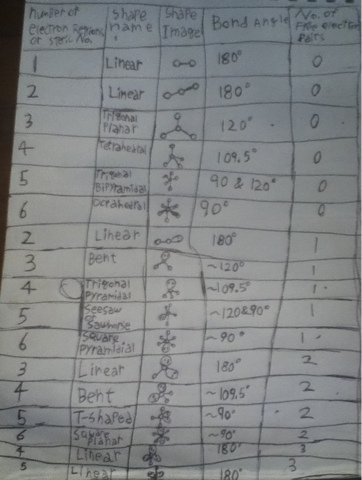
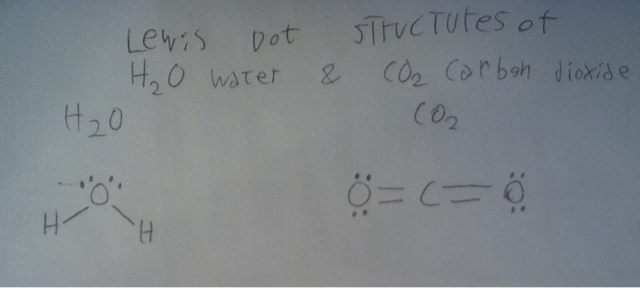 Now VSEPR has many shapes , but most of them are based on 5 common shapes ( these are the only ones in AP Chemistry , but they are more like 8 real ones and infinite theoretical ones ) Linear, Trigonal Planar, Tetrahedral ,Trigonal Bipyramidal and Octahedral
no free electron pairs | 1 free e- p | 2 f e- p | 3 f e- p | 4 f e- p | 5 f e- p |
Linear ( there is not anything based on this, its like HCl , one atom bonded to another )
Trigonal Planar Bent Linear - - -
Tetrahedral Trigonal Bent Linear - -
pyramidal
Trigonal Bipyramidal Seesaw T-Shaped Linear Linear -
Octahedral Square Square T-Shaped Linear Linear
pyramidal planar
First you draw the placement , in this case its easy
H Cl
Then you draw the bond(s)
( in this case there is only one bond , H can only make 1 bond since it has only 1 valence electron )
H-Cl
Then you fill in any missing electrons as dots, Cl has 7 valence and the line of a bond is 2 so there are 6 missing around the chlorine
..
H-Cl:
''
well its a bit hard to do it on the computer, but on paper its easy.
Now VSEPR has many shapes , but most of them are based on 5 common shapes ( these are the only ones in AP Chemistry , but they are more like 8 real ones and infinite theoretical ones ) Linear, Trigonal Planar, Tetrahedral ,Trigonal Bipyramidal and Octahedralno free electron pairs | 1 free e- p | 2 f e- p | 3 f e- p | 4 f e- p | 5 f e- p |
Linear ( there is not anything based on this, its like HCl , one atom bonded to another )
Trigonal Planar Bent Linear - - -
Tetrahedral Trigonal Bent Linear - -
pyramidal
Trigonal Bipyramidal Seesaw T-Shaped Linear Linear -
Octahedral Square Square T-Shaped Linear Linear
pyramidal planar
 |
| List of some VSEPR theory shapes |
Wednesday, June 10, 2015
AP Chemistry : kinetics and rate
The rate of a reaction is its speed , and its slope in a graph. It is in units of concentration (usually molarity ) over time (usually seconds ) M/s. The rate law is in the form : rate=k[A]^m[B]^n
Where k is the rate constant ( which is variable with temperature and a few over things ) A and B are the reactants and the [ ] around them mean Molarity which is a unit of concentration. The m and n are orders of the reaction and they can be many numbers but the most common ones are 0 , 1 and 2. The Rate or speed of a reaction changes with changes in temperature, surface area, concentration, orientation and the presence of a catalyst. Increased temperature increases the reaction rate because of the equation k=Ae^-Ea/RT ( k increases with increased temperature , since T is on the denominator of a negative exponent on a directly proportional figure to k ), and because increased temperature increases the speed of the reactants so they collide and react more often. Increased surface area increases the rate of reaction because there are more reactants that you can collide with and react. Increased concentration increases the rate of the reaction because there are extra reactants and the likely-hood of a collision and reaction is increased ( also because of the rate law , at least mathematically ). Molecules need the correct orientation to have a reaction when they collide ( they also need the required amount of energy , supplied to them by temperature ), And finally the catalyst increases the reaction rate by (" splitting" the Ea, activation energy ) and lowering the Ea. The activation energy is the minimum energy required for a reaction to happen. If the reaction is 0th order , then its graph ( of M/time , M on the y axis and time on the x axis ) is a straight slope, if its 1st then the graph is curved and if its 2nd it is also curved ( but differently than the 1st order ). To make the 1st order have a straight slope you graph the natural logarithm of Molarity over time ( lnM/t) . And to make the 2nd order straight , you graph the reciprocal of molarity over time ( 1/M / t ). With 1st order reactions you can do half life problems , the equation is t1/2=.693/k where t1/2 is the half life. To figure out the orders of reactants and thereby the overall order of the reaction you can use either the method of initial rates or mechanisms. To do the method of initial rates you have a data table of concentrations of reactants in different trials and the initial rate in each trial ( you get this data by experiment). You find where one reactant changes concentration in the trials and all the others stay the same in the same trials . Then you figure out the factor by which the reactant changes. Then you figure out the factor by which the initial rate changes in the same trials. You then figure out what exponent needs to be added to the factor of change by the reactant to equal the factor of change by the initial rate and this is the order. Where mechanisms can be used, you look at the slow step and use the coefficients of the reactants in it for the rate law. A mechanism has several elementary steps that add together to make the overall reaction
Monday, June 1, 2015
AP®* chemistry exam
May 5 : I took the AP Chemistry Exam yesterday. June 1: it was okay, I'm pretty sure I passed. Here is a quick summary of the format ,contents and details: AP Chemistry is divided into 6 big ideas, They are Big idea 1 Matter , Atoms and spectroscopy , Big idea 2 Bonding , Intermolecular forces and molecular shape , Big idea 3 Reactions, stoichiometry and electrochemistry , Big idea 4 Kinetics, Rate and half life , Big idea 5 Thermochemistry, Enthalpy and entropy , Big Idea 6 Equilibrium, Acid-Base rxns and reversible rxns. These are the basic things leaned in the big ideas, and the big ideas may have different names, but they are more or less the same. There are also 7 science practices for all the science AP exams. The Exam is broken into two parts , the Multiple choice section and the Free response section. Each is worth 50% of your grade, The multiple choice is 90 minutes long , while the Free response is 105 minutes long. The Multiple choice has 60 questions with 4 options each. There is only one right answer and there is no penalty given if you get a question wrong, You are NOT allowed a calculator during this section. I am NOT allowed to discus the Multiple choice questions I saw on this exam , so I will not give you any examples. The free response section has 3 long questions and 4 short questions. Most of them have multiple parts, and long questions have more parts than short ones. You ARE allowed a calculator in this section. I am allowed to share these as long as college board has released them , ( which they have ). There is sometimes a laboratory question in the free response. but luckily there wasn't one this year .The responses are handwritten in a booklet and hand graded sometime this June. Points are awarded for correct answers , but are not usually taken away unless you do not use the proper units ( or you do not use unit at all ) and if you contradict a previous correct answer. There are a maximum of 10 points awarded for long questions and a maximum of 4 points awarded for short questions which adds up to a maximum of 46 points in the free response section. To make the sections each worth 50 % of your grade they multiply the free response points earned by ( about ) 1.3043478260869565. They then add up earned points in both sections and divide by 120 then multiply by 100 to get you percentage. There are five scores you could get : a 5, a 4, a 3 | this is the pass line ( for the college I sent my scores too ) | a 2 and a 1.
The percentage/score conversion varies per exam, so you can never tell. They will release the scores in July ( I can't see them online ,since I can't get a college board account. Because I am under 13 ) I will get an email around the 6th and then I can call them and get my scores. Each person who takes exams has an eight digit AP number. This way they can be identified and receive their scores. I have one, but I am not allowed to share it with anybody really..... I will tell you my scores when I get them. Also Starting next week , I will write about one subject in AP chemistry a week until I get my scores.
* AP® is a registered trademark of the College Board , which was not involved in the production of, and does not endorse , this blog ( and the next ones to come ) ( by the way I had to copy that ® off Wikipedia ) so when I keep using it just keep this in mind
The percentage/score conversion varies per exam, so you can never tell. They will release the scores in July ( I can't see them online ,since I can't get a college board account. Because I am under 13 ) I will get an email around the 6th and then I can call them and get my scores. Each person who takes exams has an eight digit AP number. This way they can be identified and receive their scores. I have one, but I am not allowed to share it with anybody really..... I will tell you my scores when I get them. Also Starting next week , I will write about one subject in AP chemistry a week until I get my scores.
* AP® is a registered trademark of the College Board , which was not involved in the production of, and does not endorse , this blog ( and the next ones to come ) ( by the way I had to copy that ® off Wikipedia ) so when I keep using it just keep this in mind
Tuesday, January 13, 2015
The Ocean a poem
Oh the ocean
the ocean
the beautiful blue shiny ocean
the ocean
Oh the ocean
on the ocean
the wind in your face the salty air in your nose
walking on soft squishy sand and the waves lapping at your feet
but the all of a a sudden down your dog goes
in a crack between the rocks, but before the water would her meet
two men came and pulled her out
she ran back home
away from the spout
there afar you see a boat of foam
and it sails to you
full of pirates and vikings of old
they attack put you throw some goo
and they get stuck in there, wishing for gold
you walk back towards your car
enjoying the sun and the seagulls from afar
you get back to your car and drive to your house
on your way you almost hit a mouse
the ocean
Oh the ocean
the beautiful blue shiny ocean
the ocean
the beautiful blue shiny ocean
the ocean
Oh the ocean
on the ocean
the wind in your face the salty air in your nose
walking on soft squishy sand and the waves lapping at your feet
but the all of a a sudden down your dog goes
in a crack between the rocks, but before the water would her meet
two men came and pulled her out
she ran back home
away from the spout
there afar you see a boat of foam
and it sails to you
full of pirates and vikings of old
they attack put you throw some goo
and they get stuck in there, wishing for gold
you walk back towards your car
enjoying the sun and the seagulls from afar
you get back to your car and drive to your house
on your way you almost hit a mouse
the ocean
Oh the ocean
the beautiful blue shiny ocean
Sunday, October 26, 2014
Subscribe to:
Posts (Atom)